When Elon Musk confirmed that the upcoming second-generation Tesla Roadster would feature an optional SpaceX package capable of brief low-altitude flight, the automotive world shifted from ordinary hypercar comparisons to aerospace engineering. By pairing a tri-motor electric powertrain with composite overwrapped pressure vessels (COPV) and cold-gas thrusters, the vehicle blurs the boundary between high-downforce street machine and hovering spacecraft.
While reservation holders eagerly await street deliveries, enthusiast owners and restyling shops are already mapping out the unique aesthetic and physical demands of wrapping a vehicle that fires high-pressure nitrogen jets. Below is the complete engineering breakdown of how the SpaceX thruster package functions, how to protect vinyl wraps from cryogenic gas blowouts, and how to pilot a fully wrapped Tesla through a Martian supersonic flight simulator directly in your browser.
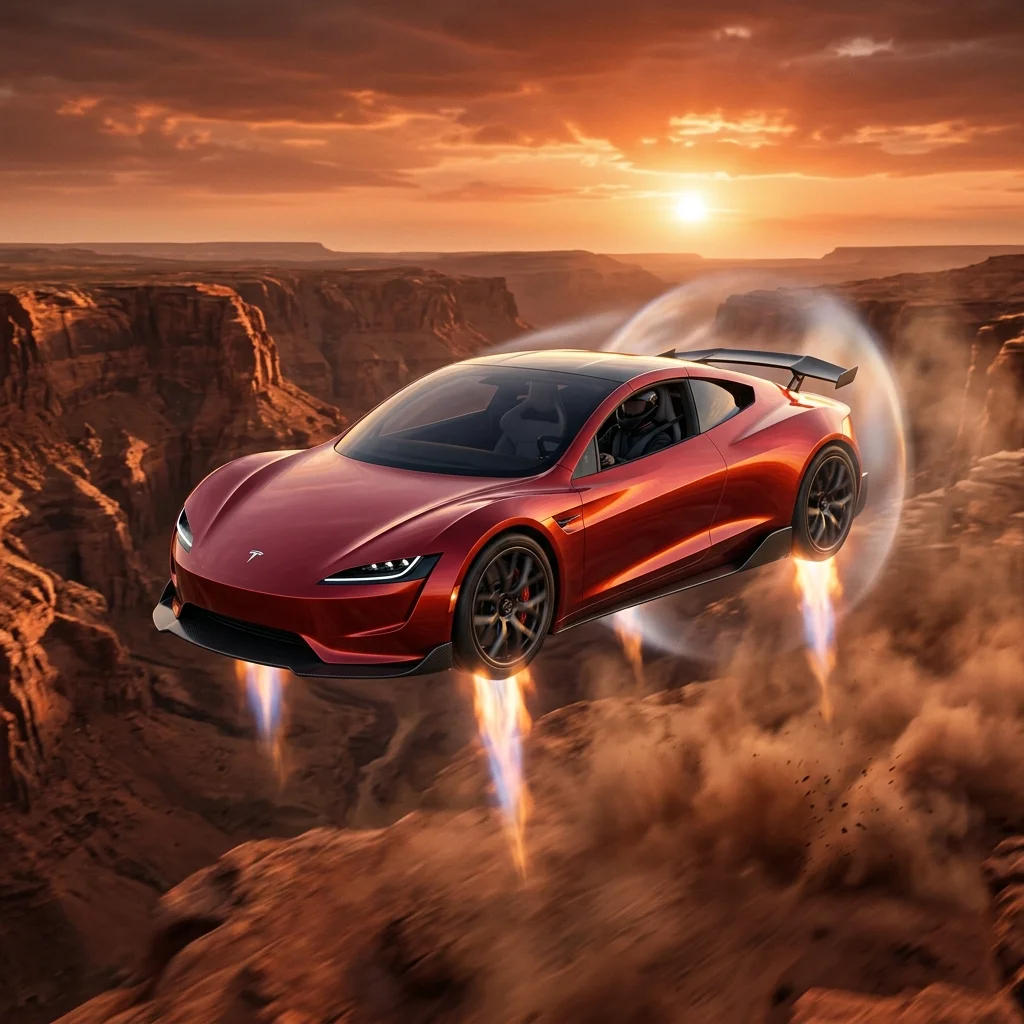
Next-generation Tesla Roadster testing low-altitude hover physics over a canyon landscape with an aerodynamic Mars Red wrap finish.
How Does the Tesla Roadster SpaceX Package Actually Fly?
The concept of a “flying car” typically conjures images of bulky folding wings, quadcopter rotors, or vertical takeoff and landing (VTOL) passenger drones. The Tesla Roadster takes a fundamentally different approach rooted in orbital rocket attitude control:
- Cold-Gas Reaction Control Thrusters (RCS): Instead of combusting rocket fuel or spinning massive blades, the vehicle installs approximately ten cold-gas thruster nozzles sourced from SpaceX Falcon 9 rocket hardware.
- COPV High-Pressure Storage: Compressed air or nitrogen is held at roughly 10,000 PSI (690 bar) in ultra-lightweight carbon-wrapped pressure tanks placed in the space normally occupied by the 2+2 rear passenger seats.
- High-Flow Electric Air Compressor: An onboard battery-powered compressor periodically re-pressurizes the tanks using surplus energy from the main 200 kWh traction battery pack.
- Vector Inversion for Lift vs. Downforce: In maximum acceleration mode, rearward-facing thrusters hidden behind the mechanized license plate fire horizontally to achieve 0–60 mph sprints in under 0.9 seconds. In flight mode, downward-angled nozzles positioned beneath the wheel wells and underfloor diffusers generate instantaneous vertical lift, counteracting terrestrial gravity (or Martian 0.38g gravity) to hover or hurdle obstacles.
- Short Flight Bursts: Because compressed gas depletes rapidly during continuous discharge, real-world low-altitude hops are calibrated for bursts lasting 10 to 45 seconds before the compressor requires replenishment.
Technical Comparison: Base Roadster 2 vs. SpaceX Package vs. Flight Simulator
The mechanical differences between a standard street-legal electric roadster and the thruster-equipped flight craft dictate every aspect of vehicle dynamics and styling:
| Engineering Dimension | Standard Tesla Roadster 2 (Tri-Motor) | Roadster 2 with SpaceX Package | TeslaWrap3D Mars Flight Simulator |
|---|---|---|---|
| 0–60 mph Acceleration | 1.9 seconds | Sub-1.0 second (approx. 0.85s) | Instantaneous Mach 1.5+ Warp Boost |
| Top Speed | 250+ mph (400+ km/h) | 250+ mph (restricted by tire limits) | Mach 3.20 (Martian supersonic glide) |
| Vertical Lift / Flight Capability | None (pure ground vehicle) | Low-altitude hover & levitation hops | Continuous 3D supersonic canyon flight |
| Propulsion Hardware | 3 Plaid carbon-sleeved motors | 3 Motors + 10 SpaceX COPV cold-gas thrusters | Simulated dual wheel & stern vector thrusters |
| Cabin Layout | 2+2 Four-passenger coupe | 2-Passenger track cockpit (tanks in rear) | Full custom virtual cockpit HUD |
| Atmospheric Environment | Earth sea-level air density (1.225 kg/m³) | Earth highway & closed proving grounds | Martian Valles Marineris canyon (0.020 kg/m³) |
| Surface Film Demands | Standard 3.5-mil cast vinyl wrap | Aerospace cast vinyl + cryogenic thermal seals | Real-time procedural 3D livery rendering |
| Public Availability | Pending commercial delivery | Extreme limited option tier | Playable now online in any web browser |
Wrapping an Aerospace-Grade Roadster: Thermal and Friction Realities
Wrapping an electric vehicle that operates near supersonic boundary layers and fires cold-gas rocket thrusters introduces unique material requirements that traditional restyling shops rarely encounter:
1. Joule-Thomson Cryogenic Shock Around Thruster Ports
When gas stored at 10,000 PSI expands into the atmosphere through a convergent-divergent nozzle, the Joule-Thomson effect triggers an immediate, dramatic drop in temperature. The localized surface around nozzle cutouts can plunge below -40°F (-40°C) in fractions of a second. Cheaper calendered vinyl wraps turn brittle and crack when exposed to rapid thermal shocks. Installers must use premium cast films—such as 3M Scotchcal IJ180mC or Avery Dennison Supreme Wrapping Film—which retain dimensional elasticity across wide thermal envelopes (-65°F to 225°F).
2. High-Shear Jet Blast and Edge Sealing
High-velocity cold-gas exhaust rushing across rocker panels, wheel arches, and rear diffusers creates extreme aerodynamic shear forces. If vinyl edges are trimmed with raw seams, the high-pressure jet stream will catch the film edge and peel the wrap off the bodywork. Wrap technicians must apply dedicated acrylic 3M Edge Sealer 3950 along all panel terminations within 12 inches (30 cm) of any thruster outlet.
3. Clear Bra PPF Reinforcement on Leading Aerodynamic Edges
At speeds exceeding 200 mph, airborne dust, tire kickback, and micro-particles hit front splitters and intake bezels like sandblasting media. Applying a layer of 8-mil to 10-mil self-healing Paint Protection Film (PPF) over top of the decorative vinyl wrap ensures front-end longevity without sacrificing finish brilliance.
4. Popular Color Schemes for Aerospace Styling
Owners seeking an authentic aerospace look gravitate toward curated palettes that reflect spaceflight history:
- Mars Ochre Red: A rich satin-metallic terracotta crimson that mirrors the oxidized iron surface of Martian regolith.
- Starship Polished Steel: Mirror-reflective liquid chrome or brushed aluminum vinyl resembling the stainless-steel hull of SpaceX Starship.
- Stealth Matte Carbon: Ultra-deep satin black paired with raw carbon weave accents, absorbing light for a tactical interceptor profile.
- Cyber Plasma Cyan: High-gloss electric turquoise inspired by ionized thruster plumes and cyberpunk bioluminescence.
How to Test-Fly Your Custom Wrapped Tesla in the 3D Mars Flight Simulator
You do not need to wait for delivery trucks to experience what a thruster-equipped Tesla feels like at supersonic velocity. CrazyTools-TeslaWrap3D features a built-in interactive Tesla Flying Car Mars Trial, combining accurate 3D vehicle geometry with low-gravity flight physics and direct integration with our custom wrap studio:
1. Design Your Custom Livery in the 3D Studio
Start at the 3D Wrap Studio. Choose your base vehicle—whether you prefer the agile lines of a Model 3 Performance, the aggressive geometric mass of a Cybertruck, or the tri-motor stance of a Model S Plaid. Pick custom satin paint hues or generate an AI-powered racing livery. Once satisfied, your active design automatically caches in your browser workspace.
2. Enter the Mars Hangar
Navigate to the Mars Flight Experience. Your vehicle materializes inside a red-planet orbital hangar complete with ambient 8-bit synthesizer retro soundtrack. If you customized a livery in the main studio, the simulator detects your artwork and provides an option to load your exact personalized wrap onto your flight craft.
3. Select Controls and Calibrate Sensors
Choose between two refined control modes:
- Mobile Gyroscope Tilt: On smartphones and tablets, physically tilt your device forward and backward to control pitch, and roll left or right to bank through turns. Tap the Calibrate Horizon button while holding your device in a neutral, comfortable viewing position.
- Virtual Joystick / Desktop WASD: On computers, steer with
WandSfor climb and dive,AandDfor lateral banking, and pressSpaceto activate the SpaceX boost thrusters.
4. Engage FSD Autopilot or Manual Flight
If you want to sit back and observe how your custom wrap reflects canyon light at supersonic speeds, toggle the Tesla FSD Autopilot switch. The flight computer calculates optimal spline trajectories, automatically weaving through obstacles and collecting orbital energy cores. Switch back to manual control at any second for full piloting command.
5. Clear Warp Gates and Collect Energy Cores
The 60-second Mars run takes you deep into the towering rust-colored cliffs of Valles Marineris. Superconducting warp gates are positioned along a 3D musical trajectory synchronized to Beethoven’s Ode to Joy. Passing consecutively through gates without collisions builds high score multiplier combos. Collect glowing energy cores along your route to replenish your SpaceX boost gauge:
- Common Cyan Cores: 100 points and +0.4 boost seconds.
- Rare Amber Cores: 150 points and +0.8 boost seconds.
- Epic Violet Cores: 250 points and +1.6 boost seconds.
- Legendary Gold Cores: 500 points and +2.8 boost seconds.
6. Download Your Verified Flight Pass
Upon completing the 60-second canyon sprint, the flight debrief calculates your top Mach speed, warp gate precision, and total mission score to award your military rank (Cadet, Scout, Captain, Chief Test Pilot, or the elusive Starman Interplanetary Legend). Download your official Mars Recon Flight Pass PNG card with your custom-wrapped vehicle snapshot to share with fellow enthusiasts on social media.
The Horizon for Flying EVs: From Digital Twins to Highway Reality
While digital twins and web-based 3D simulators allow enthusiasts to explore thruster dynamics risk-free today, translating a vehicle with 10,000 PSI gas thrusters into consumer hands presents fascinating real-world legal and regulatory puzzles.
Motor vehicle safety standards (FMVSS enforced by NHTSA) do not contain regulatory clauses for cold-gas propulsion, while the Federal Aviation Administration (FAA) regulates anything that leaves the surface of public roads. Furthermore, high-pressure gas discharge near pedestrian crosswalks poses noise and debris clearance challenges. Tesla plans to classify flight capabilities as closed-course track modes, restricting thruster hops to private proving grounds and sanctioned drag strips.
Until those regulatory pathways solidify, interactive 3D tools provide the ideal sandbox to explore, design, and pilot the next era of automotive performance.
Ready to see how your dream livery looks at supersonic speed? Launch the Tesla Flying Car Mars Trial to test-fly the thrusters, or Preview Your Custom Wrap in 3D Studio to start designing your real-world vinyl project.
Related Guides and Reading
- Tesla Avatar Wraps and Custom Liveries: 3D and AI Design — How to design sci-fi bioluminescent graphics and custom vinyl artwork using browser AI tools.
- Tesla Cybertruck Wrap Colors, Costs and Materials Guide — Stainless steel prep, color options, and full visualizer tips for Cybertruck owners.
- Best Tesla Wrap Colors: Top Trends, Finishes and 3D Preview — Popular satin black, nardo grey, liquid chrome, and chameleon wrap trends.
- How Much Does It Cost to Wrap a Tesla in 2026? — Comprehensive price breakdown covering vinyl materials, labor hours, and shop fees.